Why AI Lead Nurturing Is Changing Customer Acquisition
AI lead nurturing uses artificial intelligence to automatically personalize and optimize how businesses communicate with potential customers throughout their buying journey. Instead of manually sending generic emails to everyone, AI analyzes behavior patterns and engagement signals to deliver the right message to the right person at exactly the right time.
Key Components of AI Lead Nurturing:
- Predictive Lead Scoring – AI assigns priority scores based on likelihood to convert
- Automated Personalization – Dynamic content custom to individual preferences and behavior
- Multi-Channel Orchestration – Coordinated messaging across email, SMS, chat, and social media
- Real-Time Optimization – Continuous testing and refinement of messaging and timing
- Conversational AI – Chatbots and virtual assistants that qualify leads 24/7
The results speak for themselves. Research shows that AI-powered lead nurturing can double response rates while halving the number of emails sent, resulting in a 5x boost in engagement. Companies using AI lead nurture see reply rates jump to over 50% when they respond to inbound messages within three minutes.
But here’s the thing – AI isn’t about replacing human connection. It’s about making those connections smarter and more timely.
The shift from manual to AI-driven nurturing is happening fast. While 91% of users say marketing automation is crucial for effective lead nurturing, most businesses are still stuck in the manual mindset – sending batch-and-blast emails and hoping for the best.
I’m Samir ElKamouny, founder of Fetch and Funnel, where I’ve helped scale countless e-commerce brands using performance-driven digital marketing strategies. Over the years, I’ve seen how AI lead nurturing transforms businesses from reactive order-takers into proactive revenue machines that consistently convert cold prospects into loyal customers.
Quick ai lead nurturing definitions:
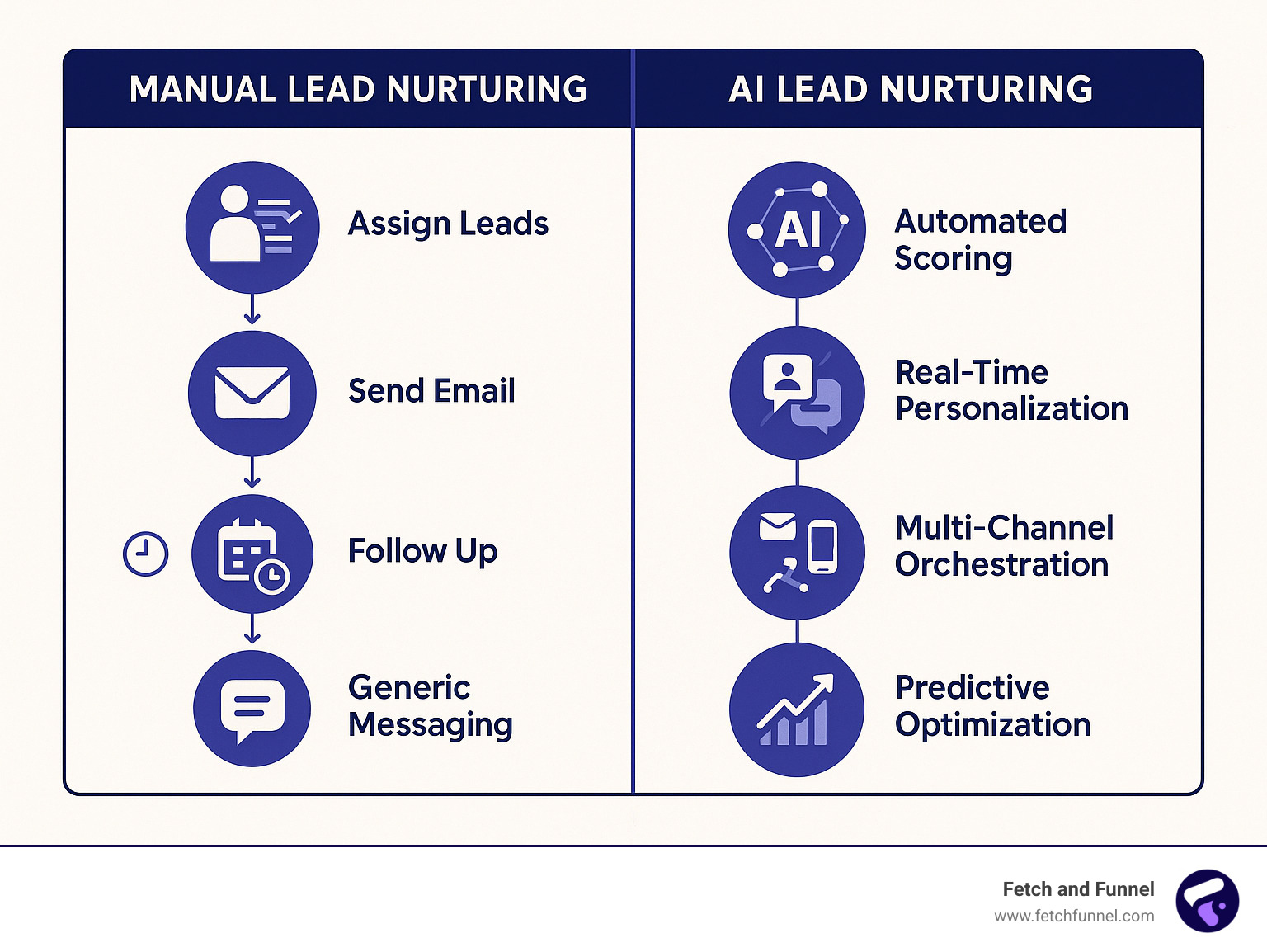
What Is AI Lead Nurturing & How It Beats Manual Methods
AI lead nurturing combines artificial intelligence and machine learning to automatically guide prospects through your sales funnel. Instead of manually writing emails and hoping you remember to follow up, AI systems analyze thousands of data points to figure out exactly what each lead needs and when they need it.
The difference is like having a crystal ball for your sales process. When someone visits your pricing page three times in one week, the AI doesn’t just make a note – it automatically sends a personalized email addressing pricing concerns and alerts your sales team.
| Feature | Manual Nurturing | AI Lead Nurturing |
|---|---|---|
| Response Time | Hours to days | Minutes (often under 3 minutes) |
| Personalization | Limited, template-based | Dynamic, behavior-driven |
| Scalability | Linear with team size | Exponential |
| Consistency | Varies by rep | Consistent across all leads |
| Data Analysis | Basic reporting | Predictive analytics |
| Cost per Lead | High (labor intensive) | Lower at scale |
Benefits of AI Lead Nurturing
The benefits of AI lead nurturing go way beyond just saving time. Here’s what we’ve seen working with clients at Fetch and Funnel:
Response rates that actually matter. AI-driven emails hit 40% response rates compared to the single-digit rates most businesses see with generic autoresponders. The secret? AI personalizes based on actual behavior, not just “Hi [First Name]” tricks.
Lightning-fast responses. AI systems reply to new leads within minutes, not hours. This speed matters more than you might think – leads are 100 times more likely to convert when you respond within five minutes instead of waiting an hour.
Personalization at scale. Manual nurturing might customize with names and company info. AI goes deeper, personalizing based on browsing history, content preferences, and even the tone of previous interactions. Scientific research on personalization benefits shows that 71% of consumers expect personalized experiences from brands they engage with.
Smart lead scoring takes the guesswork out of sales prioritization. Instead of hoping your gut instinct is right, AI analyzes patterns from thousands of past conversions to predict which leads are most likely to buy next week.
Potential Limitations & Challenges
AI lead nurturing isn’t magic, and it’s important to understand where it can stumble. Garbage in, garbage out – if your customer data is messy or incomplete, your AI will make poor decisions. Clean, comprehensive data is absolutely essential.
Integration headaches are real. Connecting AI systems to your existing CRM, email platform, and other tools can get complicated fast. The robot trap is something we see businesses fall into regularly – over-automation makes communications feel cold and impersonal.
Compliance complexity can’t be ignored. AI systems need to handle data privacy regulations and follow anti-spam laws. Upfront investment in time and resources is substantial, though AI nurturing saves money long-term.
Core Components of an AI Lead Nurturing System
Building an effective AI lead nurturing system is like assembling a high-performance engine – every component needs to work perfectly together. After helping dozens of businesses implement these systems at Fetch and Funnel, I’ve learned that success comes down to getting five core pieces right.
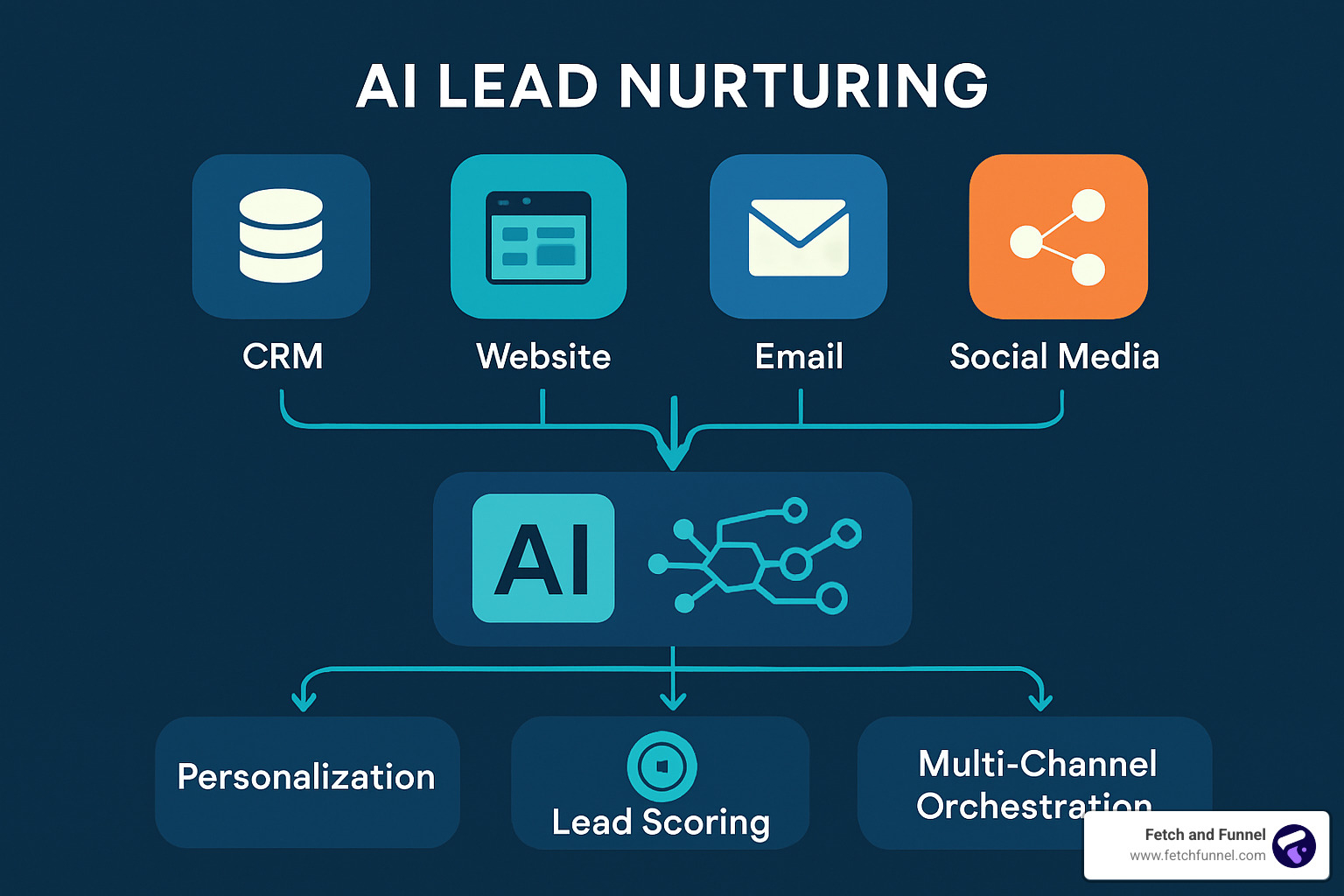
Think of it this way: your data unification layer acts as the central nervous system, gathering signals from every customer touchpoint. This feeds your predictive scoring engine, which acts like a crystal ball, telling you which leads are ready to buy. Your personalization system then crafts the perfect message for each person, while conversational AI handles the immediate back-and-forth. Finally, your optimization hub constantly fine-tunes everything to get better results.
More info about AI Marketing Automation shows how these components fit into your broader marketing strategy.
Data Unification & Integration
AI lead nurturing is only as smart as the information it has access to, which is why data unification forms the foundation of everything else.
Most businesses have customer data scattered across a dozen different places. Your website analytics, CRM, email platform, social media, and sales calls all contain valuable insights. The data unification layer brings all this information together into one complete picture of each lead.
Modern systems rely heavily on APIs and connector platforms like Zapier to sync data between different tools. But here’s where many businesses stumble – they focus on collecting more data instead of ensuring the data they have is clean and accurate.
Data hygiene becomes absolutely critical. Duplicate contacts, inconsistent formatting, and outdated information can cause your AI to make wrong decisions. The key is establishing clear rules about what data gets collected, how it’s formatted, and who maintains it.
Predictive Lead Scoring Engine
Traditional lead scoring feels like playing darts blindfolded. AI-powered lead scoring is like having perfect vision – it analyzes hundreds of variables to predict exactly which leads are ready to buy.
The machine learning models behind predictive scoring learn from your past conversions. They identify patterns that humans might miss, like the fact that leads who visit your pricing page on Tuesday afternoons are 40% more likely to request a demo within 48 hours.
These systems track behavioral signals far beyond basic page views. They analyze time spent on specific pages, scroll depth, email engagement patterns, and social media interactions.
The real power comes from dynamic prioritization. Instead of static scores that change slowly, AI scoring updates in real-time. A lead might start the day with a medium score, but after downloading a case study and visiting your pricing page twice, they jump to high priority and trigger immediate sales outreach.
Personalization & Content Automation
This is where AI lead nurturing gets really exciting. Instead of sending the same boring email to everyone on your list, AI creates unique experiences for each individual based on their interests, behavior, and buying stage.
Dynamic email personalization goes way beyond inserting someone’s first name. The AI analyzes what topics each lead engages with, what content formats they prefer, and what messaging gets them to take action.
SMS personalization adds another powerful channel for timely outreach. When a high-intent lead visits your pricing page, they might receive a text within minutes offering to answer questions.
Web personalization changes your website content based on who’s visiting. First-time visitors see educational content and social proof, while returning high-intent leads see prominent pricing information and demo requests.
More info about AI Customer Engagement explores how to create these personalized experiences across all your marketing channels.
Conversational AI Assistants
Conversational AI solves one of the biggest problems in lead nurturing – being available when prospects have questions. Your best leads often visit your website outside business hours, and waiting until tomorrow for answers means losing them to competitors who respond faster.
Modern chatbots and virtual assistants can engage prospects in natural conversations, ask smart qualifying questions, and collect important information to improve future nurturing.
The 5-minute response rule is crucial here. Leads who get responses within 5 minutes are dramatically more likely to convert than those who wait longer. AI assistants can provide instant answers, schedule meetings, and capture contact information 24/7.
Natural language processing allows these systems to understand what prospects really mean, not just what they type. The key is finding the right balance between automation and human interaction.
Implementing AI Lead Nurturing Techniques That Actually Work
Getting AI lead nurturing up and running isn’t like installing a new app on your phone. It’s more like learning to drive – you need the right preparation, practice, and patience before you’re cruising down the highway.
At Fetch and Funnel, we’ve watched too many businesses rush into AI implementation only to hit roadblocks they could have avoided. The companies that succeed take a methodical approach, starting with solid foundations and building up gradually.
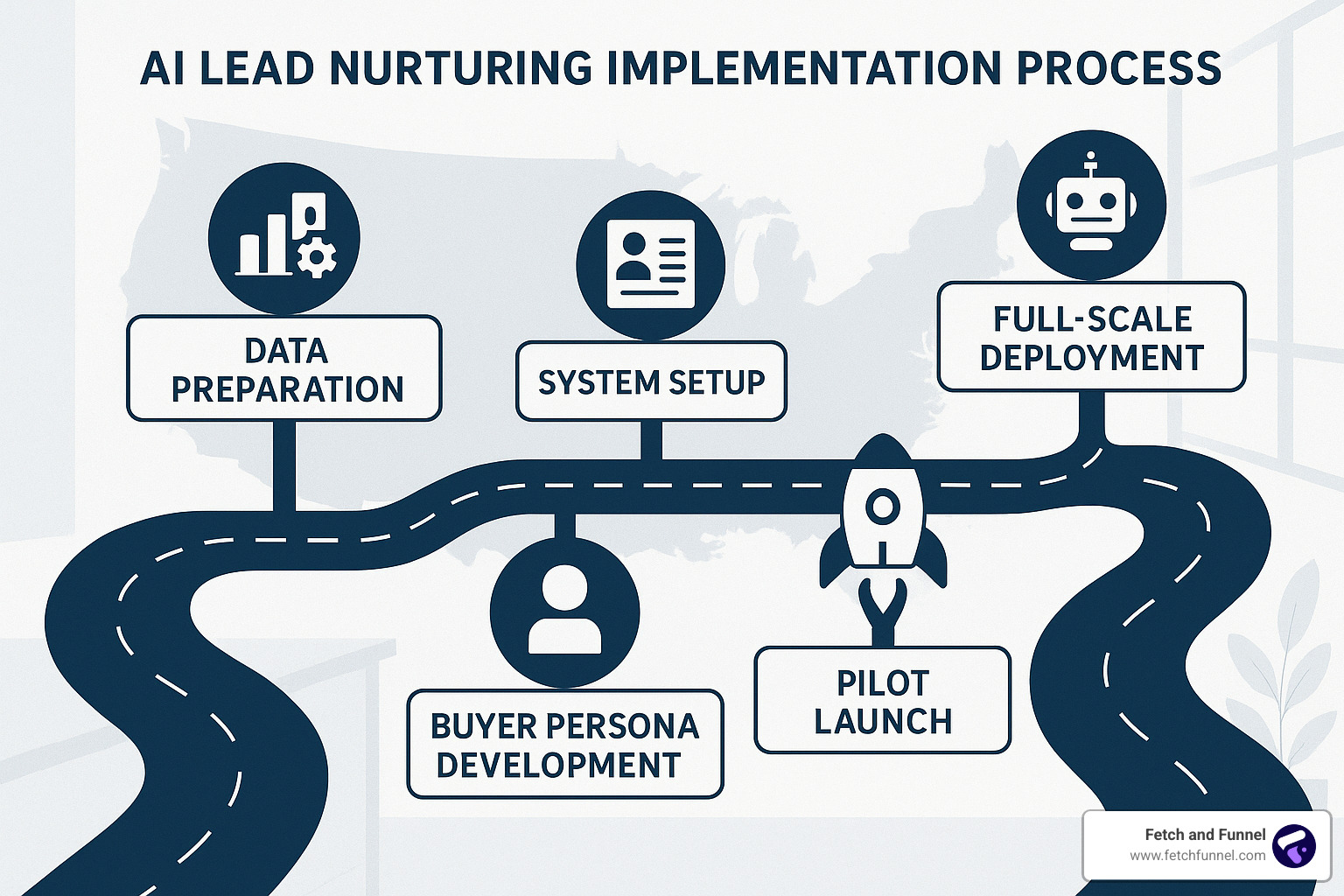
The typical implementation timeline runs 3-6 months from start to finish. That might sound long, but rushing this process usually means starting over later. The secret sauce? Start with a focused pilot program instead of trying to automate your entire lead nurturing process overnight.
Preparing Data & Buyer Personas
Here’s the truth nobody wants to hear: AI lead nurturing is only as smart as the data you feed it. Before you even think about AI tools, take a hard look at what information you’re actually collecting about your leads.
Start with a data audit. What behavioral signals are you tracking? How complete are your contact records? Intent signals deserve special attention because they’re pure gold for AI systems. These are the breadcrumbs prospects leave behind – like visiting your pricing page three times in one week or downloading competitor comparison guides.
Your buyer personas need an upgrade too. AI works best with behavior-based personas that capture how different types of prospects actually move through your funnel. Instead of “small business owner,” think “cost-conscious buyer who researches extensively before making decisions and prefers email over phone calls.”
Selecting the Right Tech Stack
The AI lead nurturing software landscape feels like a crowded bazaar where every vendor promises to revolutionize your business. Cut through the noise by focusing on what actually matters for your specific situation.
Integration capabilities should be your top priority. The fanciest AI features won’t help if the system can’t connect with your existing CRM, email platform, and website. Look for platforms with robust APIs and pre-built connectors to your current tools.
Scalability matters more than you might think. That startup-friendly platform might work great for 1,000 leads but crash and burn at 10,000. The budget conversation extends beyond monthly software fees – factor in implementation time, training costs, and potential consulting needs.
Designing Multichannel Workflows
Effective AI lead nurturing doesn’t just send better emails – it orchestrates experiences across every touchpoint where prospects encounter your brand. Think of it as conducting a symphony where email, SMS, website personalization, social media, and even direct mail all play their parts in harmony.
Email remains the backbone of most nurturing programs, but it shouldn’t operate in isolation. A prospect might download a resource from your website, triggering an educational email sequence. When they return to your site, website personalization shows relevant case studies. After engaging with a few emails, an SMS follow-up offers a consultation.
More info about How to Nurture Leads provides detailed guidance on creating these multichannel workflows that actually convert.
Balancing Automation with the Human Touch
Here’s where many AI lead nurturing implementations go wrong: they automate everything and forget that people still want to buy from people. The most successful programs use AI to make human interactions more strategic and effective, not to replace them entirely.
AI excels at routine tasks and qualification – initial lead scoring, educational content delivery, behavioral tracking, basic FAQ responses, and meeting scheduling. Humans shine at relationship building and complex conversations – needs assessment, objection handling, custom solution design, and contract negotiation.
Sales alignment becomes absolutely critical. Your AI system should alert sales reps when leads reach buying readiness, provide context about previous interactions, and suggest optimal next steps.
Quick-Start Checklist
Starting your AI lead nurturing journey doesn’t have to feel overwhelming. Break it down into manageable weekly goals:
Weeks 1-2:Define clear goals and success metrics.Audit your existing data sources and honestly assess data quality. Document your current lead nurturing processes and identify key buyer personas.
Weeks 3-4:Research and evaluate AI nurturing platforms.Test integrations with your existing systems before committing. Plan your data migration and secure budget approval.
Weeks 5-8:Create initial nurturing workflows for just one persona. Develop content assets and email templates.Set up tracking and analytics and train team members on new processes.
Weeks 9-12:Start with a small audience segment to test your workflows. Monitor performance metrics daily during the first few weeks. Collect feedback and iterate based on results before scaling.
Remember: the goal isn’t perfection from day one. It’s building a system that learns and improves over time.
Measuring Success & Future Trends in AI Lead Nurturing
Measuring AI lead nurturing success goes way beyond counting email opens and clicks. While those metrics still matter, AI gives us something much more powerful – the ability to trace nurturing activities directly back to actual revenue.

At Fetch and Funnel, we’ve learned to focus on the metrics that actually move the needle: conversion rates, pipeline velocity, customer lifetime value, and cost per acquisition. These tell the real story of whether your AI nurturing is working or just making pretty reports.
Scientific research on customer-experience ROI shows that companies investing in customer experience see 2-3x higher revenue growth rates than their competitors.
Tracking Performance & ROI
The beauty of AI lead nurturing is that it creates a treasure trove of data you can actually use to improve your business.
Conversion metrics tell you how well your nurturing actually works. Lead-to-opportunity conversion rates show if you’re attracting the right people. Opportunity-to-customer rates reveal whether your nurturing prepares leads for sales conversations. Pipeline velocity often improves dramatically with AI because prospects receive more relevant, timely information.
Engagement metrics help you understand what resonates with your audience. Email engagement rates matter, but so do website behaviors like return visits and time spent on key pages. Content consumption patterns reveal which topics interest different segments.
Efficiency metrics demonstrate the business impact of automation. Cost per lead typically drops as AI systems get better at targeting. Sales team time savings can be substantial – some of our clients report their reps spend 40% less time on administrative tasks.
Revenue metrics provide the ultimate measure of success. Customer lifetime value often increases because AI-nurtured leads arrive better educated and more committed. Average deal sizes may grow when prospects receive targeted content that helps them understand the full value of your solution.
Upcoming Innovations
The future of AI lead nurturing looks pretty exciting, and some of these innovations are already starting to appear in forward-thinking businesses.
Generative AI content creation will revolutionize personalization. Instead of choosing from pre-written email templates, AI will craft unique content for each prospect based on their specific interests, industry challenges, and behavioral patterns.
Adaptive journey orchestration means your nurturing sequences will become truly dynamic. If a prospect’s company announces a major acquisition, the AI might immediately shift messaging to address new integration challenges.
Voice AI integration will extend nurturing beyond text-based interactions. Prospects might have phone conversations with AI assistants that sound remarkably human, scheduling meetings or answering complex questions.
Privacy-first modeling addresses growing concerns about data collection and usage. As cookies disappear and regulations tighten, AI systems will become more sophisticated at personalizing experiences using only first-party data.
Continuous Improvement Loop
Here’s something we’ve learned from years of implementing AI lead nurturing systems: the magic happens in the ongoing optimization, not the initial setup. The most successful programs treat AI nurturing as a living system that evolves with changing customer behavior and market conditions.
Every interaction generates data that makes future performance better. Successful conversions reveal which nurturing sequences work best for different prospect types. Failed opportunities highlight where messaging might be off-target or timing might be wrong.
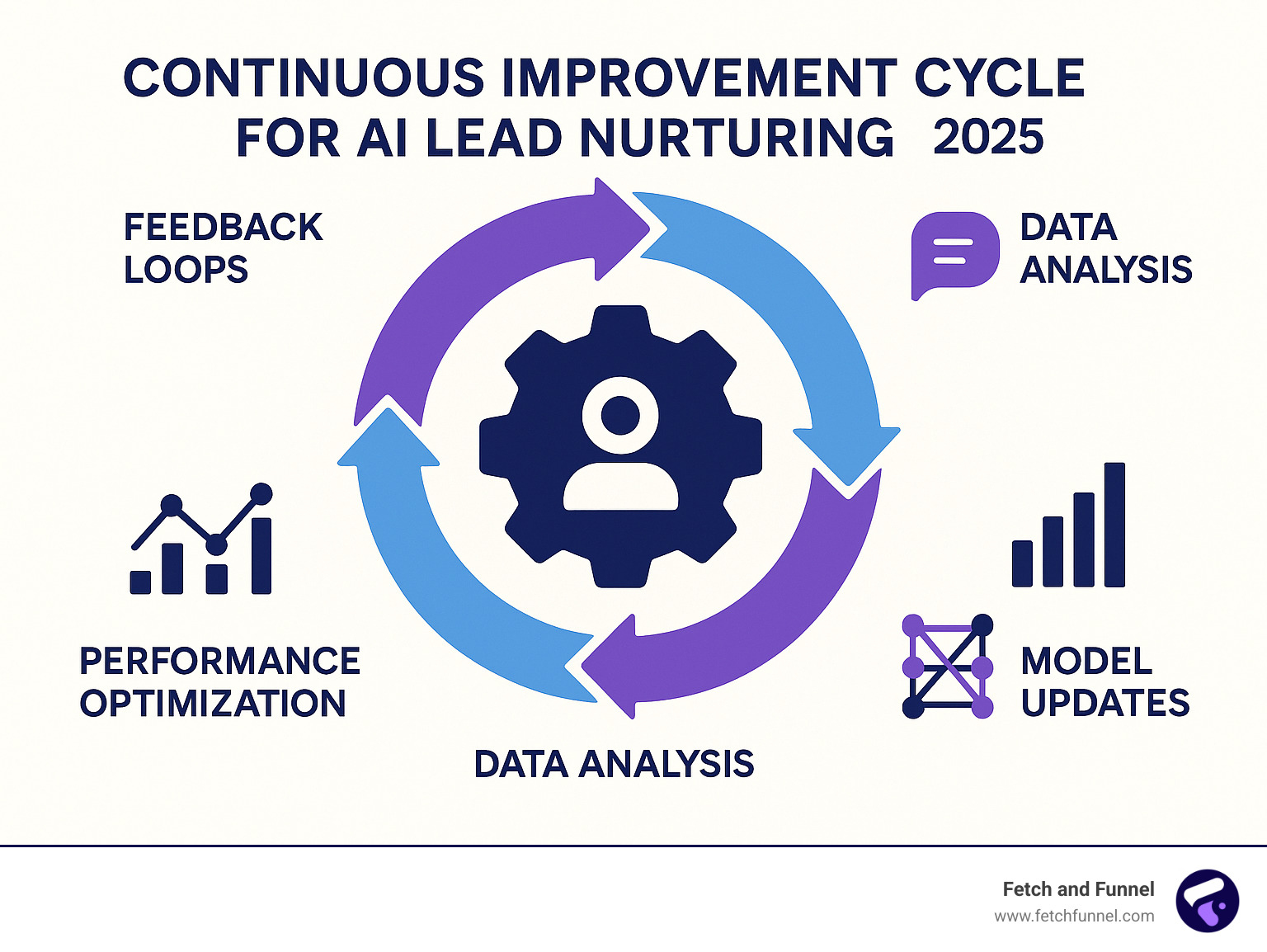
Model retraining keeps your AI systems sharp and current. Customer behavior evolves constantly – what worked six months ago might be less effective today. Regular model updates with fresh data ensure your system stays accurate and effective.
Cross-team collaboration reveals insights that individual departments miss. Monthly reviews involving marketing, sales, and customer success teams often uncover optimization opportunities.
The key insight is that AI nurturing success comes from treating it as an ongoing conversation with your prospects rather than a static campaign.
Frequently Asked Questions about AI Lead Nurturing
What data do I need to start AI lead nurturing?
Getting started with AI lead nurturing doesn’t require perfect data – it just needs good enough data to begin learning and improving.
The essential foundation includes your basic contact information like names, emails, company details, and job roles. Add in your website behavioral data showing which pages people visit and how long they stay. Your email engagement history – who opens what and clicks where – provides crucial insights.
Clean CRM data matters more than having massive amounts of messy information. I’d rather work with 1,000 clean, accurate lead records than 10,000 incomplete ones full of duplicates and outdated information.
As your system matures, you can layer in firmographic details like company size and industry, plus behavioral events like content downloads and competitor research. Privacy considerations are crucial here – make sure you’re collecting data ethically and have proper consent.
How does AI lead scoring actually work?
AI lead scoring is like having a detective that never forgets a case. It studies every successful customer you’ve ever had, identifies the patterns that led to those wins, and then spots similar patterns in new prospects.
The system starts by analyzing your historical conversion data. It looks at customers who bought from you and works backward to understand what they did before purchasing. Maybe successful customers typically visit your pricing page three times, download two case studies, and engage with your LinkedIn content.
Machine learning algorithms then process hundreds of variables simultaneously – not just obvious things like job title and company size, but subtle behavioral signals like scroll depth on your website or the time of day someone opens emails. This creates a predictive model that assigns scores based on conversion likelihood.
The beautiful part is continuous learning. Every new conversion teaches the system something new, making the scoring more accurate over time.
Will AI replace my sales reps?
Here’s the truth: AI lead nurturing won’t replace your sales team any more than email replaced phone calls. Instead, it handles the tedious stuff so your reps can focus on what humans do best – building relationships and solving complex problems.
AI excels at augmentation, not replacement. It’s brilliant at routine follow-ups, scheduling meetings, qualifying basic fit, and personalizing content at scale. Your AI never forgets to follow up, never has a bad day, and can work with hundreds of leads simultaneously.
But when it comes to human-centered activities like understanding nuanced business challenges, providing strategic consultation, or navigating complex negotiations, your sales team remains irreplaceable.
The most successful companies we work with at Fetch and Funnel use AI to create more time for relationship-focused activities. Their reps spend less time on data entry and email scheduling, and more time having meaningful conversations with qualified prospects.
Human oversight keeps everything on track. Someone needs to set strategy, monitor performance, and make judgment calls when situations get complex. Think of AI as your most reliable team member – incredibly efficient at specific tasks, but still needing direction and supervision.
Conclusion
The change from manual lead nurturing to AI lead nurturing isn’t just about keeping up with technology – it’s about fundamentally changing how you connect with potential customers. We’ve seen the numbers: 5x engagement boosts, 50% response rates, and dramatic time savings that let your team focus on what humans do best.
At Fetch and Funnel, we’ve watched countless businesses struggle with the old way of doing things. Manual follow-ups, generic email blasts, and missed opportunities were killing their growth potential. But when they acceptd AI lead nurturing, something remarkable happened. They stopped chasing leads and started attracting them naturally.
The beauty of AI nurturing lies in its ability to scale genuine personalization. While your competitors are still sending “Dear [First Name]” emails, you’re delivering content that speaks directly to each prospect’s specific needs and interests. It’s like having a conversation with hundreds of people simultaneously – something impossible with manual methods.
The human element remains irreplaceable. AI doesn’t replace your sales team’s expertise, empathy, or relationship-building skills. Instead, it amplifies these strengths by ensuring every human interaction happens at the perfect moment with the right context. Your reps spend less time on administrative tasks and more time building meaningful connections that close deals.
Starting your AI lead nurturing journey doesn’t require a complete overhaul of your existing processes. Begin with clean data, choose technology that integrates well with your current systems, and launch a focused pilot program. The key is taking that first step rather than waiting for perfect conditions that never come.
The competitive advantage is real and growing. While 91% of businesses recognize the importance of marketing automation, most are still stuck in manual mode. Early adopters of AI nurturing are already seeing the benefits – higher conversion rates, shorter sales cycles, and teams that actually enjoy their work again.
Ready to see what AI lead nurturing can do for your business? More info about AI Lead Nurture shows how Fetch and Funnel helps companies implement AI systems that actually work – without the complexity or confusion that often comes with new technology.
The future of customer acquisition is already here. The question isn’t whether AI will transform how businesses nurture leads – it’s whether you’ll be leading that change or scrambling to catch up. Your prospects are ready for smarter, more personalized experiences. Are you ready to deliver them?