Stop Leaving Money on the Table: Why Conversion Rate Optimization Matters
Conversion rate optimization ecommerce is the process of systematically improving your online store to increase the percentage of visitors who complete desired actions like making purchases. If you’re looking to boost sales without increasing ad spend, here’s what you need to know:
Quick Guide to Ecommerce CRO:
1. Average conversion rate: 2-3% across industries
2. Formula: (Number of conversions ÷ Total visitors) × 100
3. Top strategies:
– Optimize product pages with high-quality images and clear descriptions
– Streamline checkout process and offer guest checkout
– Add social proof through reviews and testimonials
– Ensure mobile responsiveness and fast page load times
– Implement personalized product recommendations
If you’re running an ecommerce store, you’re likely facing a familiar challenge: plenty of traffic but not enough sales. You’re not alone. While the average ecommerce conversion rate hovers between 2-3%, top-performing stores achieve 5-10% by optimizing every step of the customer journey.
Think of it this way: doubling your conversion rate from 2% to 4% effectively doubles your revenue without spending an extra dollar on advertising. That’s the power of conversion rate optimization.
“It is actually damn easy to increase conversions; just sell everything for $1—boom! True optimization is about profit, not just conversion rate.”
The truth is, most ecommerce businesses are leaving money on the table. With $7.31 trillion projected to be spent on ecommerce by 2025, even small improvements in your conversion rate can translate to significant revenue gains. But here’s the catch—it’s not about random tweaks or following generic “best practices.” Effective CRO requires a systematic, data-driven approach.
Whether you’re struggling with shopping cart abandonment (which averages a staggering 69.82%), low product page engagement, or ineffective CTAs, this guide will equip you with proven strategies to transform browsers into buyers.
I’m Samir ElKamouny, founder of Fetch and Funnel, and I’ve helped countless ecommerce brands dramatically improve their conversion rate optimization ecommerce strategies, turning traffic into revenue through data-driven testing and optimization.
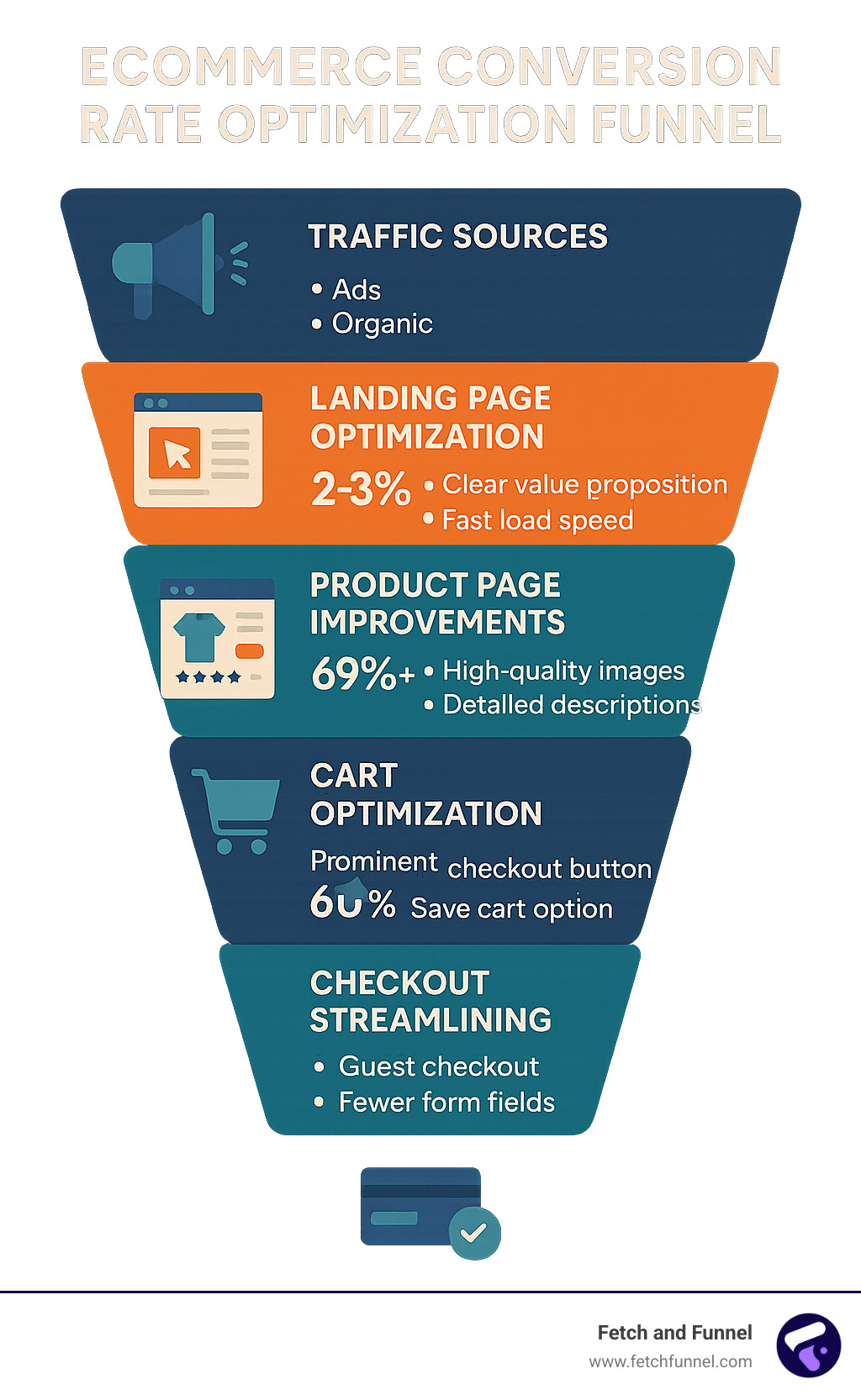
Learn more about conversion rate optimization ecommerce:
– conversion rate optimization best practices
– conversion rate optimization tools
– conversion rate optimization testing
Why This Guide Matters
Ecommerce is growing at an unprecedented rate. As more businesses move online and competition intensifies, simply driving traffic to your store isn’t enough. At Fetch and Funnel, we’ve seen that the brands scaling most profitably aren’t necessarily the ones with the biggest ad budgets—they’re the ones optimizing their conversion funnels.
The math is simple: if you’re spending $10,000 on ads to drive 10,000 visitors with a 2% conversion rate, you’ll get 200 customers. Bump that conversion rate to 4%, and you’ll get 400 customers for the same ad spend. That’s the difference between breaking even and becoming highly profitable.
This guide matters because it focuses on getting more value from your existing traffic—something every ecommerce business owner needs to master for sustainable growth.
What Is Conversion Rate Optimization Ecommerce?
Conversion rate optimization ecommerce is like turning up the efficiency dial on your online store. Instead of constantly chasing new traffic (and spending more money), CRO helps you make the most of visitors already coming to your site by changing more of them into paying customers.
Think of it as fine-tuning your store to match how real people actually shop. When we work with clients at Fetch and Funnel, we always remind them that “People don’t buy from websites, they buy from people.” This simple truth guides everything in effective CRO—creating experiences that feel natural and frictionless for actual humans, not just checking boxes on a best practices list.
Let me put the value in real dollars: if your store makes $100,000 monthly with a 2% conversion rate, bumping that to just 3% would bring in an extra $50,000 every month. That’s an additional $600,000 yearly without spending another penny on ads. Pretty compelling, right?
Definition & Key Metrics
At its heart, conversion rate optimization ecommerce looks at two types of customer actions:
Macro-conversions are the big wins—completed purchases where money changes hands. But equally important are micro-conversions—smaller steps that lead toward purchase, like signing up for emails, creating accounts, adding products to carts, saving items to wishlists, or even just viewing product details.
Calculating your conversion rate is straightforward:
Conversion Rate = (Number of Conversions ÷ Number of Visitors) × 100
So if 5,000 people visited your store last month and 150 made purchases, your conversion rate would be 3% (150 ÷ 5,000 × 100).
While tracking conversion rate is essential, it works best alongside other indicators. Watch your bounce rate to see if visitors are leaving immediately, exit rate to identify problem pages, click-through rates on important elements, how long people stay on your site, how many pages they view, and especially your cart abandonment rate—those almost-sales that slipped away at the last moment.
Good Conversion Benchmarks
Most ecommerce stores convert between 2-4% of visitors, but what’s “good” varies widely based on what you sell, your industry, and your price points.
Here’s a simple way to gauge where you stand:
Below 1% suggests serious problems needing immediate attention. 1-2.5% is below average with lots of room to grow. 2.5-3% puts you in average territory—not bad, but nothing to brag about. 3-5% is when you’re outperforming most competitors. Above 5% and you’re in the ecommerce elite.
Different industries have different norms. Fashion typically sees 1.4-3% conversion rates, while Health & Beauty runs 2-3.5%. Home & Garden products convert around 1.7-2.8%, Electronics hover at 1.4-2.5%, and Food & Beverage sits at 1.5-3%. Luxury Goods naturally convert lower at 0.8-1.5% due to higher prices and consideration time.
Remember though, as one expert wisely noted, “Average conversion rates (1-4%) are largely meaningless for individual businesses.” Your most important benchmark is your own progress over time.
Beyond the Rate: Supporting KPIs
While conversion rate gets the spotlight, it’s just one actor in your ecommerce performance story. For the full picture, keep an eye on these supporting metrics:
Average Order Value (AOV) tells you how much customers spend per order. If your conversion rate jumps 20% but AOV drops 25%, you’re actually losing money despite more sales. Calculate it by dividing total revenue by number of orders.
Customer Lifetime Value (CLV) looks at the long game—how much a customer is worth over their entire relationship with your store. A high CLV might justify a lower initial conversion rate if customers keep coming back. Find it by multiplying average order value by purchase frequency by average customer lifespan.
Bounce Rate flags potential problems with page relevance, loading speed, or user experience. High bounces mean visitors are leaving without engaging.
Exit Rate helps pinpoint exactly where customers are dropping out of your funnel, showing you which pages need the most attention.
Engagement Metrics like time on site and return visit rate indicate whether visitors find your content valuable enough to stick around.
By taking this more holistic view, you’ll avoid the common trap of chasing conversion rate improvements that actually hurt your bottom line. The goal isn’t just more conversions—it’s more profitable conversions that build lasting customer relationships.
Measure First: Data & Diagnostics
Before jumping into changes on your store, you need to know what’s actually happening. After all, you can’t fix what you don’t understand.
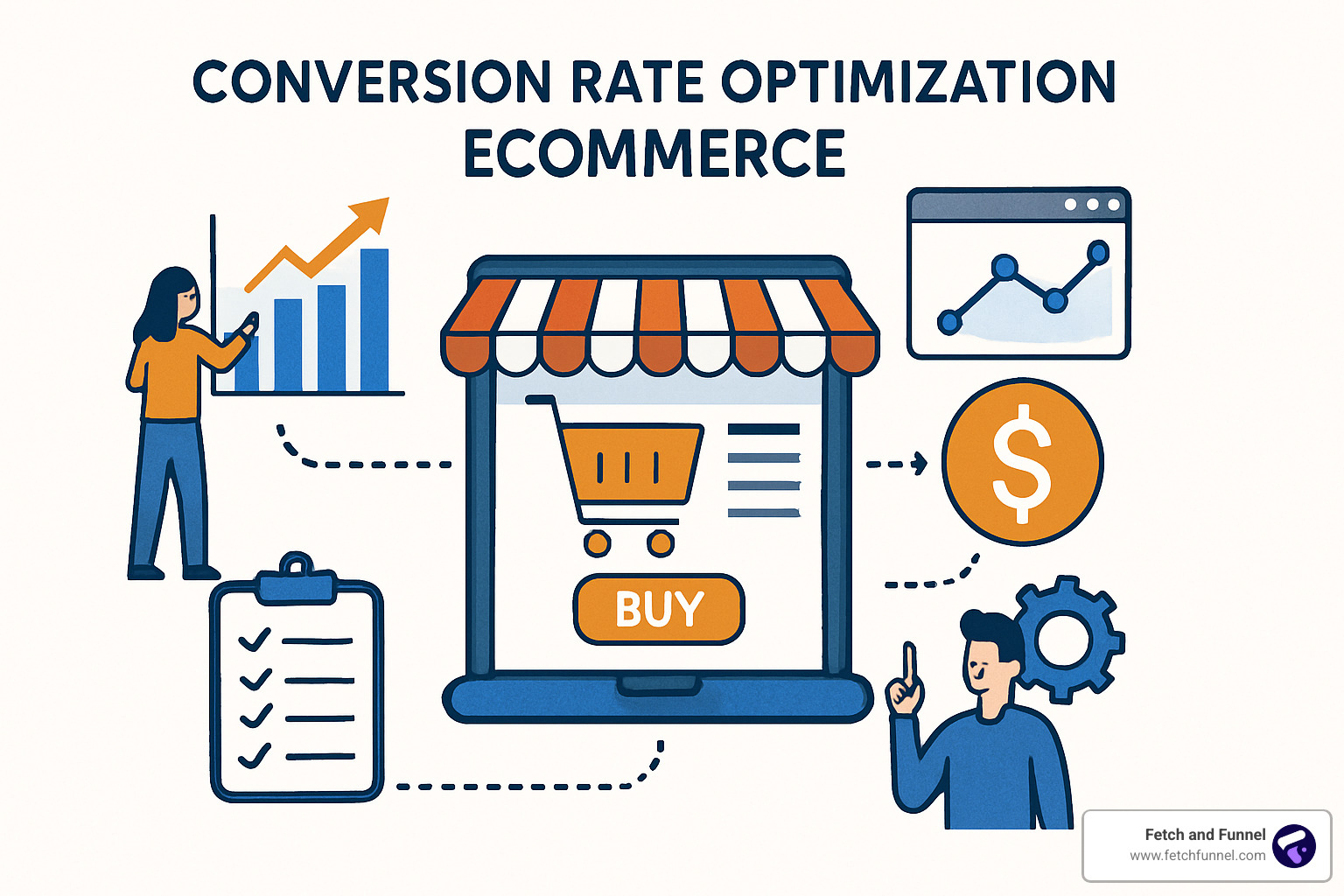
When we start with a new client at Fetch and Funnel, we always begin with a thorough analytics check-up. It’s like getting a complete physical before starting a new workout routine. Here’s what this diagnostic phase looks like:
First, we ensure your Google Analytics 4 is properly set up with ecommerce tracking turned on. This gives us visibility into your entire purchase funnel, from first click to final purchase. Without this foundation, you’re essentially flying blind.
Next, we map your conversion funnel step by step. This funnel analysis reveals exactly where shoppers are dropping off – maybe it’s on product pages, during checkout, or somewhere unexpected. These drop-off points are your biggest opportunities for improvement.
Heatmaps add a visual dimension to your data. Tools like Hotjar or Lucky Orange show exactly where users click, hover, and scroll on your pages. It’s fascinating (and sometimes surprising) to see what elements grab attention and which ones get ignored.
Want to really understand your customers? Session replays let you watch actual shoppers steer your store. It’s like sitting behind them as they browse, showing you exactly where they get confused or frustrated. We’ve solved countless conversion mysteries this way.
Finally, don’t forget to actually talk to your customers. The voice of customer data from surveys, polls and interviews often reveals issues you’d never spot in analytics alone. One client finded their shipping policy was confusing customers simply by asking “What questions do you have before purchasing?”
These diagnostic tools answer critical questions about your store:
– Where exactly are visitors abandoning your funnel?
– Which elements grab attention (or get completely ignored)?
– What’s stopping people from hitting that “buy” button?
– What questions or concerns are holding shoppers back?
Funnel Analysis is particularly valuable as it visualizes the customer journey and highlights your biggest conversion leaks. Similarly, Behavior reports show how users actually steer through your store.
For a complete toolkit, check out our guide to Conversion Rate Optimization Tools.
Quantitative Deep Dive
Google Analytics 4 (GA4) should be your home base for hard numbers. Here’s where to focus your attention:
Break down your conversion rate optimization ecommerce data into meaningful segments. Look at traffic sources (do organic visitors convert better than paid?), devices (is your mobile experience underperforming?), new vs. returning visitors, and geographic locations.
Track key events throughout your funnel – product views, add-to-carts, checkout starts, purchases, and email sign-ups. This helps identify exactly where friction occurs.
Pay special attention to pages with high exit rates – these are where customers are saying “no thanks” and leaving. Products with high view-to-cart ratios are your winners, while those with low ratios need improvement. And always investigate any significant drop-offs during checkout.
The differences can be striking. I recently worked with a beauty brand whose mobile users converted at just 1.2% while desktop users hit 3.8%. That gap represented a huge opportunity to improve their mobile experience.
Qualitative Goldmine
Numbers tell you what’s happening, but customer feedback tells you why. This context is pure gold for effective conversion rate optimization ecommerce.
On-site polls catch shoppers in the moment. We love exit-intent polls that ask “What prevented you from completing your purchase today?” The answers often reveal fixable problems you never knew existed.
Post-purchase surveys are equally valuable. “What almost stopped you from buying today?” uncovers obstacles that future customers might not overcome.
Usability tests show how real people interact with your store. Watching someone get confused by your navigation or struggle to find shipping information is eye-opening. We’ve seen countless “aha!” moments during these sessions.
User interviews go deeper into customer motivations and pain points. A 30-minute conversation can reveal insights that transform your understanding of what shoppers really want.
At Fetch and Funnel, we’ve found the magic happens when you combine both types of data. The numbers point you to problem areas, while customer feedback tells you exactly what to fix. It’s like having both a map and directions – together, they guide you to conversion success.
Identify & Remove Funnel Barriers
Think of your ecommerce site as a physical store. If customers can’t find what they’re looking for, feel uncomfortable, or face a long checkout line, they’ll walk out. The same principles apply online, but the good news is—these barriers are fixable!
At Fetch and Funnel, we analyze conversion obstacles through a simple framework:
Drivers: What motivates your visitors to take action? Is it price, quality, or solving a specific problem?
Barriers: What’s stopping them from converting? This could be confusion, lack of trust, or technical issues.
Hooks: What final persuasive elements can tip hesitant shoppers into becoming buyers?
We consistently see four major conversion killers across ecommerce sites:
UX Friction creates frustration when shoppers can’t easily steer your site or complete purchases. One client came to us with a 7-step checkout process that was bleeding customers at every step. Simplifying to 3 steps boosted their conversion rate by 34%.
Trust Issues make visitors hesitant to hand over their credit card information. Without reviews, security indicators, or clear policies, potential customers feel vulnerable and back away.
Speed Problems drive impatient shoppers away—and we’re all impatient online! A shocking 53% of mobile users will abandon a site that takes longer than 3 seconds to load. That’s right, just 3 seconds.
Mobile Limitations create major friction when sites aren’t optimized for smartphones. With most shoppers browsing on mobile devices, a poor mobile experience is like having a physical store with a tiny, hard-to-open door.
To identify your specific barriers, regularly check your Exit rate to see where users are dropping off, and use page speed tools to find performance issues that may be costing you sales.
Speed & Mobile Experience
“I’ll just wait for this slow website to load,” said no online shopper ever. Site speed isn’t just a technical issue—it’s a conversion killer. With 53% of mobile users abandoning sites that take more than 3 seconds to load, every millisecond counts.
Here’s how to give your site the speed boost it needs:
Run a Lighthouse Audit through Google to pinpoint specific speed issues. This free tool gives you actionable recommendations custom to your site.
Compress those images! We often see ecommerce sites with beautiful but massive product photos that drag load times to a crawl. Tools like TinyPNG can reduce file sizes by 70% without noticeable quality loss.
Implement lazy loading so images only load as users scroll to them. This makes initial page load much faster and provides a smoother browsing experience.
For mobile optimization, thumbs—not mice—are the primary navigation tool. Make buttons large enough to tap easily (at least 44×44 pixels), simplify navigation for one-handed browsing, and test your checkout process on various mobile devices.
Also consider that mobile users often have different intentions than desktop shoppers. They might be comparison shopping in-store or quickly researching during a commute. Design your mobile experience with these behaviors in mind, emphasizing easy product comparison and simple information access.
Trust & Social Proof
In the physical world, we use our senses to evaluate products and businesses. Online, we need different signals to feel confident in our purchases. With 89% of consumers reading reviews before buying, social proof has become the digital equivalent of trying before buying.
Customer reviews serve as your most powerful trust builders. Both the star rating and the number of reviews matter—a 4.7-star average from 1,200 reviewers typically outperforms a 5-star average from just 3 people.
User-Generated Content like customer photos and videos creates authentic validation that professional product shots simply can’t match. One of our apparel clients saw a 24% conversion increase after adding a customer photo gallery to product pages.
Trust badges might seem like small details, but they make a big difference. Display recognizable payment methods, security certifications, and industry associations prominently—especially near checkout areas.
SSL badges and security icons reassure visitors that their personal information is safe. Place these visibly near forms and checkout buttons where security concerns peak.
Transparent policies around shipping, returns, and guarantees should be easy to find. The Baymard Institute found that 11% of buyers abandoned orders because of unsatisfactory return policies. Don’t hide this information—if your policies are customer-friendly, make them a selling point!
Checkout Flow Fixes
The checkout process is where the most critical conversion happens—and unfortunately, where 69.82% of shoppers abandon their carts. This is the ecommerce equivalent of customers putting items in their basket at a physical store, walking up to the register, then changing their mind and leaving.
Implement single-page checkout whenever possible. Each additional step increases the risk of abandonment. One of our clients consolidated their 5-step checkout into a single page and saw conversions jump by 22%.
Always offer guest checkout. Forcing account creation is a conversion killer—18% of users abandon carts when sites don’t provide a guest option. You can always invite customers to create accounts after they’ve completed their purchase.
Add clear progress indicators to show customers exactly where they are in the process and how many steps remain. This reduces anxiety and uncertainty.
Minimize form fields ruthlessly. The average checkout form has 11.8 fields, but most only need 8. Each field you remove reduces friction and increases completion rates.
Pre-fill information where possible using browser autofill and address lookup tools. The less typing required, especially on mobile, the better.
Provide multiple payment options including credit cards, PayPal, Apple Pay, and other popular methods. Different customers have strong preferences for different payment types.
A construction materials site we worked with reduced checkout drop-off significantly by consolidating steps and updating copy, increasing conversions by 28%. These seemingly small changes can have dramatic impacts on your bottom line.
Conversion rate optimization ecommerce is an ongoing process of identifying and removing barriers. Start with these high-impact areas, measure the results, and keep refining. Your customers—and your revenue—will thank you.
Conversion Rate Optimization Ecommerce: 15 Battle-Tested Tricks
Now that we’ve covered the foundations, let’s dive into specific, actionable strategies that can dramatically improve your ecommerce conversion rates. At Fetch and Funnel, we’ve tested these tactics across numerous ecommerce sites and seen consistent results. These aren’t just theoretical ideas—they’re proven approaches that drive real revenue.

Personalization for Conversion Rate Optimization Ecommerce
When it comes to conversion rate optimization ecommerce, personalization isn’t just nice to have—it’s essential. A whopping 86% of consumers say website personalization influences their purchasing decisions.
Think about your own shopping experiences. Isn’t it satisfying when a site seems to “get” you? That’s the power of AI-powered product recommendations. Just like Amazon’s “Frequently Bought Together” feature, these algorithms suggest products based on browsing history and similar customer profiles, creating those “how did they know?” moments that lead to additional purchases.
Dynamic content takes this a step further by tailoring your entire site experience. Imagine showing different hero images to first-time visitors versus loyal customers, or displaying region-specific promotions based on a shopper’s location. These personalized touches create relevance that converts.
Even your email marketing can benefit from personalization. Those abandoned cart emails perform significantly better when they include not just the forgotten items but also personalized recommendations based on browsing behavior.
If you’re just getting started with personalization, check out Website personalization tools that integrate with your platform. Even implementing something as simple as a “Recently Viewed” section can lift your conversion rates noticeably.
A/B Testing for Conversion Rate Optimization Ecommerce
If personalization is the “what” of conversion rate optimization ecommerce, A/B testing is the “how.” It transforms CRO from guesswork into science.
The key to effective testing is developing clear hypotheses. Instead of vaguely deciding to “improve the checkout page,” create specific, testable statements like: “Adding trust badges near the checkout button will increase conversion rate by at least 5%.” This clarity helps you measure success and learn from every test.
Sample size matters tremendously in testing. I’ve seen many store owners get excited about early results only to watch them fade as more data comes in. For statistical significance (typically p ≤ 0.05), high-traffic sites might need just 1-2 weeks per test, while medium-traffic sites need 2-4 weeks. If your site gets under 30K monthly visitors, focus on sequential testing or bigger changes that will show clearer results.
The golden rule of A/B testing? Change just one element at a time. When you modify multiple elements simultaneously, you won’t know which change drove the improvement. Was it the new button color, the updated headline, or the repositioned reviews? Testing one variable gives you actionable insights you can build upon.
For a deeper dive into testing methodology, our Conversion Rate Optimization Testing resources provide step-by-step guidance.
High-Impact Visuals
In online shopping, your visuals do the heavy lifting that in-store experiences once provided. They’re not just decorative—they’re functional tools that drive conversions.
High-resolution product photos aren’t optional anymore—they’re expected. Research shows 33.16% of customers specifically want multiple images, and 56% immediately explore product images upon arriving at a product page. Think about it: would you buy something you couldn’t clearly see?
I’m particularly excited about 360-degree views, which allow customers to rotate products and examine them from all angles. About 60% of shoppers actively want this feature, and it makes perfect sense—it’s the digital equivalent of picking up a product in-store.
Product videos might be your most powerful visual asset. They increase organic search traffic by a remarkable 157% and can boost conversions by up to 80%. Why? Because they show your product in action, answering questions and addressing concerns that static images can’t.
Beyond just showcasing your products, high-quality visuals reduce return rates by setting accurate expectations. The customer who clearly sees what they’re buying is less likely to be disappointed when it arrives.
Smart Navigation & Search
If customers can’t find what they’re looking for, they simply can’t buy it. That’s why smart navigation and search functionality are fundamental to conversion rate optimization ecommerce.
Predictive search with autocomplete transforms the shopping experience. When a customer types “winter b—” and immediately sees thumbnail images of winter boots with prices, they’re guided directly to relevant products. This removes friction and shortens the path to purchase.
I always recommend following Apple’s approach to navigation—clean, uncluttered menus rather than overwhelming dropdowns with dozens of options. Every additional choice creates cognitive load for your customer.
Category filters are equally important, especially for stores with large inventories. A customer looking for a “medium, red, cotton sweater under $50” should be able to filter to exactly that, rather than scrolling through pages of irrelevant products.
One often-overlooked feature is the ability to search within categories rather than the entire site. This prevents scenarios where a search for “black dress shoes” returns women’s black dresses alongside men’s dress shoes.
One online retailer we worked with saw a 16-28% conversion lift simply by simplifying their navigation. Sometimes the most impactful changes are the ones that remove complexity rather than adding features.
Scarcity & Urgency
There’s a reason why limited-time offers work so well—they tap into powerful psychological triggers that motivate action. When used authentically, scarcity and urgency can significantly boost your conversion rates.
Limited-time offers with countdown timers create a sense of urgency that counters procrastination. We’re all guilty of thinking “I’ll come back to this later”—but timers make the cost of waiting tangible.
Stock indicators showing “Only 3 left in stock” provide social proof (others are buying this) while also creating scarcity. This combination is particularly powerful for products that might sell out.
Cart reservation notifications tell customers their items are held for a limited time, addressing both scarcity (these items might not be available later) and commitment (you’ve already started the purchase process).
The key with these tactics is authenticity. False scarcity damages trust, so only implement these triggers when they reflect genuine limitations. Your customers can spot manipulative tactics from a mile away.
Pop-Ups & Email Capture
Pop-ups get a bad rap, but when used strategically, they can significantly boost list growth and conversions without harming the user experience.
Exit-intent pop-ups are particularly effective because they’re triggered when users are about to leave your site. Since these visitors were leaving anyway, there’s little downside to offering a compelling reason to stay or return later.
Timing is everything with pop-ups. Timed pop-ups that display after a visitor has engaged with your site for 30+ seconds typically perform better than immediate pop-ups that interrupt the initial browsing experience.
First-purchase discounts offered through pop-ups create a win-win: customers get immediate value, and you capture an email address while incentivizing a purchase. This approach can achieve conversion rates around 9% when executed well.
The golden rule for pop-ups? Always provide clear value and an easy way to dismiss them. The pop-up that offers a genuine benefit and respects the user’s choice to decline will improve your brand rather than damaging it.
Free & Transparent Shipping
Shipping costs and policies have an outsized impact on conversion rates—they can make or break the sale at the final moment of decision.
Free shipping thresholds are magical for increasing average order value. When a customer sees “Free shipping on orders over $50” and has $42 in their cart, they’re highly motivated to find an additional item. This strategy not only increases conversions but also boosts your bottom line.
Transparency about shipping costs is non-negotiable—48% of cart abandonment occurs due to unexpected costs revealed late in the checkout process. Displaying shipping information early in the shopping journey sets accurate expectations and builds trust.
Interestingly, our research shows only 28% of shoppers are willing to pay extra for faster shipping. This suggests that for most products, free shipping is generally more influential than expedited shipping. Of course, this varies by product category—emergency replacements or gifts might warrant speed over cost.
Social Proof Amplifiers
We humans are social creatures who look to others when making decisions. Social proof strategically placed throughout your site can dramatically influence purchase behavior.
Star ratings in search results and product listings provide immediate validation before a customer even clicks through to a product page. This pre-validation increases qualified traffic to your product pages.
Review highlights that extract key positive points from customer reviews help shoppers quickly understand the real-world benefits of your products. Not everyone will read all reviews, but most will scan these highlights.
Customer photos showing real people using your products are particularly powerful for apparel and lifestyle products. They help potential buyers visualize themselves using or wearing the item, which is a crucial step in the purchase decision.
The statistics are compelling: 95% of shoppers rely on reviews to evaluate product suitability. This makes review collection and display one of the most powerful conversion levers available to ecommerce brands.
Wishlists & Save-for-Later
Not every site visitor is ready to buy right now, but that doesn’t mean they never will. Wishlist features create a bridge between browsing and buying.
About 40% of online shoppers actively want a wishlist feature to save items they’re interested in but not ready to purchase. Without this option, these interested-but-not-ready shoppers simply leave—and often forget to return.
Beyond serving customers, wishlists provide valuable data collection opportunities. They reveal which products generate interest but face purchase hesitation, helping you identify potential friction points to address.
Wishlists also enable cross-device shopping, allowing customers to start browsing on mobile during their commute and complete purchases on desktop later. This flexibility aligns with how people actually shop today.
The humble wishlist can significantly increase both conversion rate and average order value while providing remarketing opportunities—making it one of the most underrated features in ecommerce.
Pricing Psychology
How you present prices can significantly influence perceived value and conversion decisions. Small tweaks in pricing strategy can yield substantial results.
Charm pricing—using prices ending in .99 or .97—continues to work despite consumer awareness of the tactic. These prices are consistently perceived as significantly lower than rounded numbers, even when the difference is just a penny.
Bundle discounts create a perception of increased value while simplifying the decision process. One clothing retailer we worked with increased sales by over 50% by implementing a “3 for $X” bundling strategy that actually improved margins while boosting conversion rates.
Price anchoring shows the original price alongside the sale price, highlighting the savings. This creates a reference point that makes the current price feel like a better value, even for shoppers who weren’t familiar with the original price.
As we like to say at Fetch and Funnel, “True optimization is about profit, not just conversion rate.” Ensure your pricing strategies maintain healthy margins while driving conversions.
Retargeting & Cart Recovery
With nearly 70% of carts abandoned, recovery strategies represent one of your biggest opportunities for quick revenue gains.
Triggered emails sent within an hour of abandonment perform significantly better than delayed messages. These timely reminders can recover anywhere from 3% to 15% of otherwise lost sales, making them one of the highest-ROI tactics in ecommerce.
For time-sensitive offers or products, SMS reminders can complement email recovery efforts. Text messages have higher open rates than emails, though they should be used judiciously to avoid feeling intrusive.
Progressive incentives start with a simple reminder, then offer increasingly valuable incentives in subsequent messages. This approach preserves margin on easily recovered sales while still capturing those who need additional motivation.
The best cart recovery strategies don’t just remind customers what they abandoned—they address likely reasons for abandonment, such as shipping costs, delivery timeframes, or product questions.
Live Chat & Support
Sometimes all a customer needs to convert is an answer to a specific question. Real-time assistance through live chat can address concerns that might otherwise prevent conversion.
Proactive chat invitations triggered by specific behaviors—like dwelling on a page or viewing multiple product variants—can address hesitations at critical moments. These targeted interventions feel helpful rather than intrusive because they respond to signals of confusion or indecision.
The chatbot-human handoff creates the perfect balance of efficiency and personalization. AI chatbots handle initial questions and common issues, with seamless transfer to human agents for complex scenarios that require empathy or nuanced understanding.
Strategic chat placement matters tremendously. Position chat widgets on high-consideration pages like product details and checkout, where questions are most likely to arise and most valuable to answer.
Live chat consistently earns the highest satisfaction score across all support channels, but implementation matters. Non-user-initiated pop-ups can be more annoying than helpful if they appear at the wrong moment.
Copy That Converts
In the rush to optimize images, design, and functionality, copy often gets overlooked—yet it directly impacts conversion rates at every stage of the funnel.
Aim for a sixth-grade reading level in your product descriptions and site copy. This isn’t about “dumbing down” your content—it’s about making it accessible and easy to process. Even sophisticated shoppers appreciate clarity.
Benefit-driven headlines focus on what the product does for the customer, not just features. Instead of “500 Thread Count Egyptian Cotton Sheets,” try “Sleep Better Tonight with Ultra-Soft Sheets That Stay Cool All Night.”
Scannable formats with bullet points, short paragraphs, and clear subheadings accommodate how people actually read online—which is to say, they don’t read, they scan. Make your key selling points easy to absorb at a glance.
Clear calls-to-action use action-oriented button text that sets accurate expectations. “Add to Cart” performs better than “Purchase” because it aligns with the actual next step in the process.
Remember: clarity trumps cleverness. Customers need to understand your offering immediately, or they’ll simply move on.
Speed Hacks
Beyond basic speed optimization, these advanced tactics can further improve performance and directly impact your conversion rates.
Content Delivery Networks (CDNs) distribute your site content across multiple servers globally, ensuring visitors receive data from the server closest to them. This reduces load times dramatically, especially for international customers.
Lazy loading images and content only as users scroll to them can cut initial page load times significantly. This prioritizes the content the user sees first, creating a perception of speed even if some below-the-fold elements are still loading.
Browser caching stores commonly used files locally in users’ browsers, so returning visitors experience much faster load times. This particularly benefits customers who browse multiple pages before purchasing.
Every second of load time can decrease conversions by up to 20%, making speed optimization one of the highest-impact CRO investments you can make. In our experience at Fetch and Funnel, speed improvements often show the fastest ROI of any optimization effort.
Continuous Testing Culture
Successful conversion rate optimization ecommerce isn’t a one-time project—it’s an ongoing process that becomes part of your business culture.
A testing roadmap prioritizes experiments based on potential impact and implementation effort. This ensures you’re tackling the highest-value opportunities first rather than getting distracted by minor tweaks.
Documentation of all test hypotheses, results, and learnings creates an institutional memory that prevents repeating unsuccessful tests and builds on previous insights. This documentation is particularly valuable when team members change.
Regular review meetings keep optimization top-of-mind and create accountability for implementing and analyzing tests. These meetings should celebrate both wins and “failures”—because tests that disprove hypotheses provide valuable insights that shape future strategy.
At Fetch and Funnel, we help clients build this testing culture by establishing clear processes and accountability for ongoing optimization. The most successful ecommerce brands don’t treat CRO as a project—they make it a permanent part of their business operations.
Tools, Testing & Continuous Improvement
Implementing effective conversion rate optimization ecommerce isn’t about throwing random tactics at the wall to see what sticks. It requires a thoughtful combination of the right tools, consistent testing, and a commitment to ongoing refinement. Let’s explore how to build your CRO ecosystem that delivers real results.
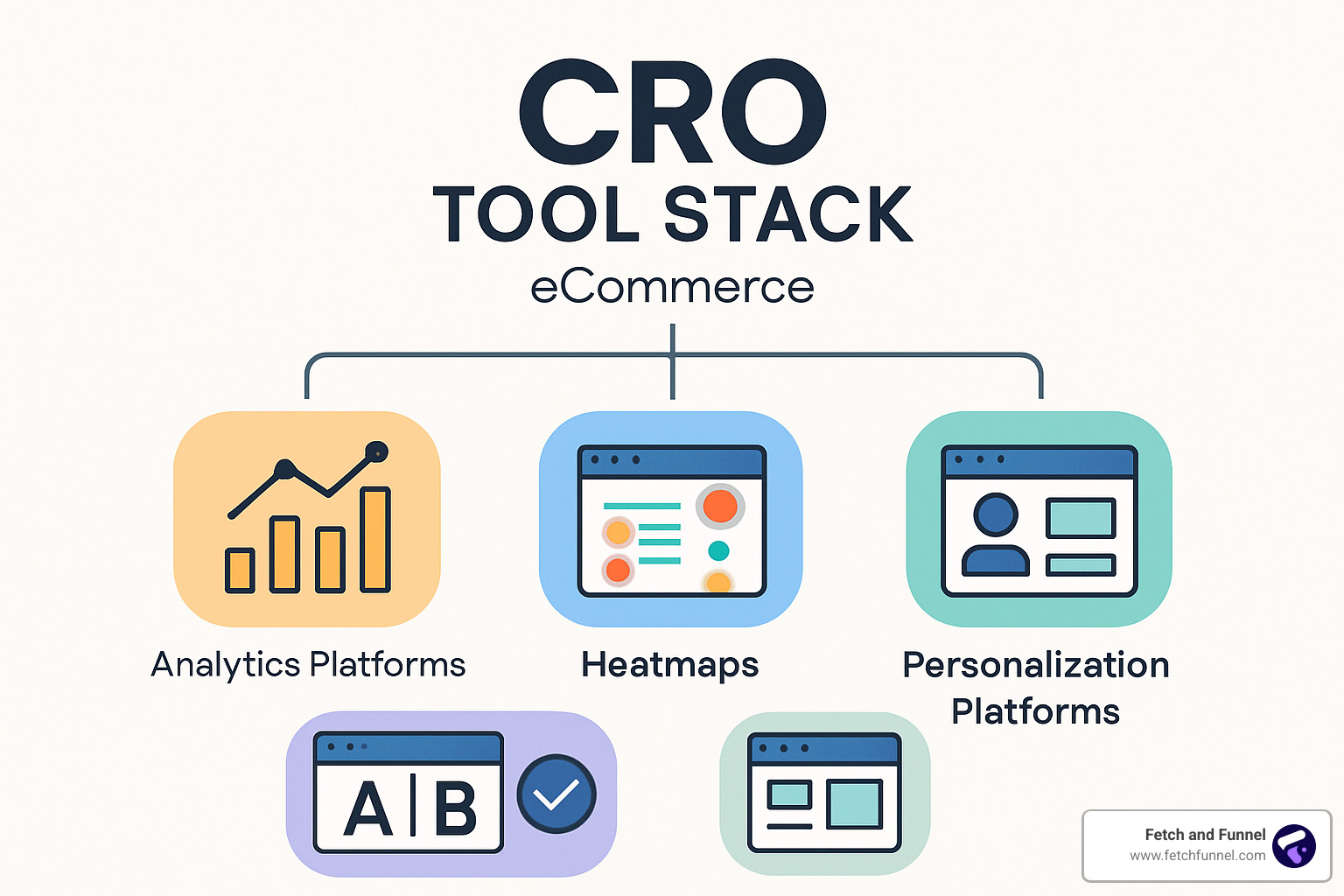
When we work with clients at Fetch and Funnel, we often find they’re missing key pieces of their optimization toolkit. A complete CRO tech stack typically includes several essential components that work together to provide a 360-degree view of your customers.
Analytics platforms like Google Analytics 4 form the backbone of your data collection, giving you visibility into user behavior and conversion metrics. Think of analytics as your compass—it tells you where you are and points you in the right direction.
Heatmap and session recording tools add color to your data by visualizing exactly how users interact with your site. Tools like HotJar and Lucky Orange let you watch users steer your store, revealing frustration points that raw numbers might miss. It’s like being able to look over your customers’ shoulders as they shop.
Personalization engines help you deliver custom experiences based on user behavior and preferences. When a returning visitor sees product recommendations based on their browsing history, that’s personalization at work—and it can dramatically lift conversion rates.
A/B testing platforms are your experimental lab, allowing you to run controlled tests to see which versions of your pages perform better. Without proper testing, you’re just guessing.
Survey and feedback tools complete the picture by giving voice to your customers’ thoughts and concerns. Sometimes the simplest way to find out why people aren’t converting is to ask them directly!
For more guidance on selecting the right tools for your specific needs, check out our guide to More info about CRO experts.
Building Your CRO Tech Stack
Start with the essentials before investing in specialized tools. Think of this as building a house—you need a solid foundation before adding fancy fixtures.
Google Analytics 4 should be your first priority. It’s free, powerful, and integrates with virtually everything else. Make sure you’ve properly configured improved ecommerce tracking, set up key conversion events, and created meaningful user segments. Without proper GA4 setup, you’re essentially flying blind.
Google Tag Manager is another must-have that simplifies implementation of tracking codes and allows for flexible data collection without constantly bothering your developers. It’s like having a central control panel for all your tracking needs.
Survey tools help bridge the gap between what users do (quantitative) and why they do it (qualitative). A simple exit survey asking “What prevented you from completing your purchase today?” can reveal insights that hours of data analysis might miss.
I always tell our clients: start simple, get the basics right, and add more specialized tools as your CRO program matures and your specific needs become clearer. There’s no need to break the bank on fancy tools if you haven’t mastered the fundamentals.
Setting Up Experiments
A/B testing might seem straightforward—create two versions, split traffic, see which wins—but there’s more to it than that. Effective testing requires a methodical approach.
First, understand your Minimum Detectable Effect (MDE)—the smallest improvement you need to detect based on your traffic volume and conversion rate. This helps determine how long your test needs to run.
Test duration is crucial. Run tests long enough to reach statistical significance, typically 1-4 weeks depending on your traffic volume. Ending tests too early is a common mistake that leads to false conclusions.
Aim for at least 95% statistical significance (p ≤ 0.05) before declaring a winner. This means you can be 95% confident that the results aren’t due to random chance.
Always control for variables that might skew your results. Seasonality, marketing campaigns, technical issues, and external events can all impact test outcomes. For example, running a test during Black Friday week will likely give you results that don’t apply to normal shopping periods.
Document everything—your hypothesis, test design, results, and learnings. This creates an institutional memory that prevents you from repeating failed experiments and helps identify patterns over time.
Here’s something that surprises many of our clients: more than half of A/B tests show no significant improvement. This isn’t failure—it’s learning! Every test, regardless of outcome, provides valuable insights that inform your next steps.
Scaling Wins Across Channels
When you do find a winning optimization, don’t stop at implementing it on your website. Look for opportunities to apply those insights across all your marketing channels.
Omnichannel consistency ensures your messaging and user experience flow seamlessly across all touchpoints. If simplified product descriptions boost conversions on your website, they’ll likely improve your email marketing performance too.
Create SEO synergy by applying CRO learnings to improve organic landing pages and content. For instance, if certain product features drive more conversions, highlight those features in your SEO content.
Use successful messaging and offers from your CRO tests in your paid ads creative. This alignment between ad promises and on-site experience reduces bounce rates and improves quality scores.
Email marketing provides another opportunity to leverage your CRO wins. Incorporate winning product descriptions, images, and CTAs in your email campaigns to drive higher click-through and conversion rates.
Don’t forget to extend successful visual and copy elements to your social media content. The messaging that resonates with your website visitors will likely connect with your social audience too.
At Fetch and Funnel, we work closely with clients to create this cross-channel coherence, ensuring that CRO insights benefit the entire marketing ecosystem. After all, the most powerful optimizations are those that lift your entire customer experience, not just isolated touchpoints.
Frequently Asked Questions About Conversion Rate Optimization Ecommerce
How do I calculate my ecommerce conversion rate?
Figuring out your conversion rate optimization ecommerce metrics doesn’t require complex math. The formula is straightforward:
Conversion Rate = (Number of Conversions ÷ Total Number of Visitors) × 100
Let’s make this real with a practical example. Say your online store welcomed 10,000 visitors last month, and 250 of those visitors completed a purchase. Your conversion rate would be:
(250 ÷ 10,000) × 100 = 2.5%
This same formula works whether you’re measuring overall purchases or tracking specific actions like email sign-ups or add-to-carts. You can also apply it to particular segments of your audience—maybe you want to know how desktop users convert compared to mobile visitors, or how different traffic sources perform against each other.
What’s considered a “good” ecommerce conversion rate today?
When clients ask us this at Fetch and Funnel, I always start with “it depends”—because it truly does! Your industry, product type, price point, and traffic sources all influence what’s realistic for your store.
That said, here’s a general framework to help you gauge where you stand:
- 1-2%: Below average (time to optimize!)
- 2-3%: Average (solid foundation to build on)
- 3-5%: Above average (you’re outperforming most competitors)
- 5%+: Excellent (whatever you’re doing, keep it up!)
If you’re selling luxury products or high-ticket items, expect rates on the lower end (typically 0.8-1.5%) because customers take longer to make these significant purchase decisions. Conversely, lower-priced consumer goods often see higher conversion rates.
I love what one of our strategists always tells clients: “There is no universal ‘good’ conversion rate—benchmarks are arbitrary and unhelpful.” Your best approach is to focus on continuous improvement against your own baseline rather than chasing industry averages.
Which metric matters after conversion rate?
While conversion rate optimization ecommerce efforts naturally focus on that headline number, viewing it in isolation can be misleading. Here are the companion metrics that provide crucial context:
Revenue Per Session (RPS) is what we call the “great equalizer.” Calculate it by multiplying your Average Order Value by your Conversion Rate. This metric helps you understand if your traffic is truly valuable—a lower conversion rate with a higher average order value might actually generate more revenue than the reverse.
Customer Lifetime Value (CLV) looks beyond the initial purchase to measure the total revenue a customer brings throughout their relationship with your brand. A high CLV justifies more aggressive acquisition strategies and can make up for a slightly lower conversion rate.
Contribution Margin ensures you’re not sacrificing profitability in pursuit of conversions. Boosting conversion rate through excessive discounting or costly features might actually harm your bottom line.
Retention Metrics like return rate, repeat purchase rate, and subscription retention tell you about the quality of customers you’re acquiring. Are they one-time buyers or loyal fans?
At Fetch and Funnel, we’ve seen businesses obsess over conversion rate while neglecting these supporting metrics—only to find they were optimizing themselves into lower profitability. True optimization balances all these factors to drive sustainable growth.
Conclusion & Next Steps
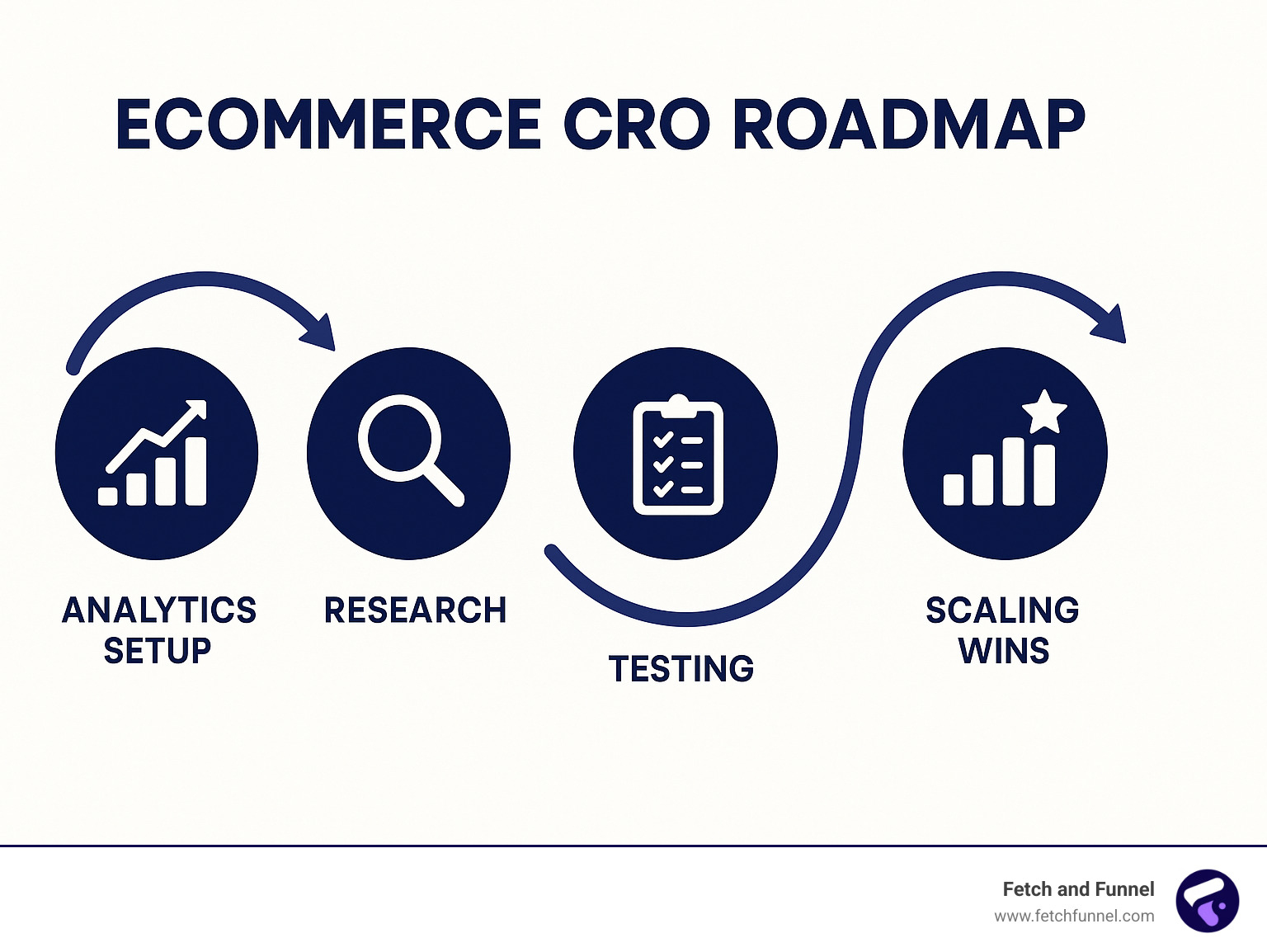
Conversion rate optimization ecommerce is not a one-time project but an ongoing process of testing, learning, and improving. By systematically applying the strategies in this guide, you can transform your ecommerce store into a high-converting sales machine.
Remember these key principles:
Start with data: Use analytics, heatmaps, and customer feedback to identify your biggest opportunities.
Prioritize impact: Focus on high-traffic pages and major friction points first.
Test methodically: Form clear hypotheses and run controlled experiments.
Think holistically: Consider the entire customer journey, not just individual pages.
Optimize for profit: Don’t sacrifice margins for conversion rate.
At Fetch and Funnel, we specialize in helping ecommerce brands implement data-driven conversion rate optimization ecommerce strategies that deliver measurable ROI. Our team in Boston combines creative expertise with analytical rigor to create experiences that convert browsers into buyers.
Ready to stop leaving money on the table? The strategies in this guide can help you start capturing more value from your existing traffic immediately. For brands looking for expert guidance, our team is ready to help you develop and implement a customized CRO strategy.
More info about our CRO services
Remember: In the competitive world of ecommerce, it’s not just about driving more traffic—it’s about making the most of every visitor. Start optimizing today, and watch your sales grow.